
Gaming, Rage, and Tragedy: Revisiting the Overwatch Murder Four Years Later
I still remember the morning I scrolled through the news and saw that a man had been arrested for killing his longtime boyfriend over a match of Overwatch. It was early 2022, and the story hit me like a freight train. Four years later, in 2026, the memory lingers as a grim reminder of how a hobby I love – competitive gaming – can intersect with real-world violence when toxicity boils over.
Back on January 6, 2022, Docquen Jovo Watkins called police in Pontiac, Michigan, to report a fight with his partner of ten years, Rory Teasley. He told deputies that Teasley was sleeping on the couch after their dispute. When authorities arrived, Teasley was unconscious and not breathing. He was rushed to a hospital but was pronounced dead shortly after. According to NBC, the argument stemmed from an Overwatch session. The exact details remain murky, but Sheriff Michael Bouchard’s words stuck with me: “We see far too often across the country these days when people resort to violence over trivial and insignificant disagreements.” He added there is never a justification for violence over a disagreement, no matter how heated things get online.
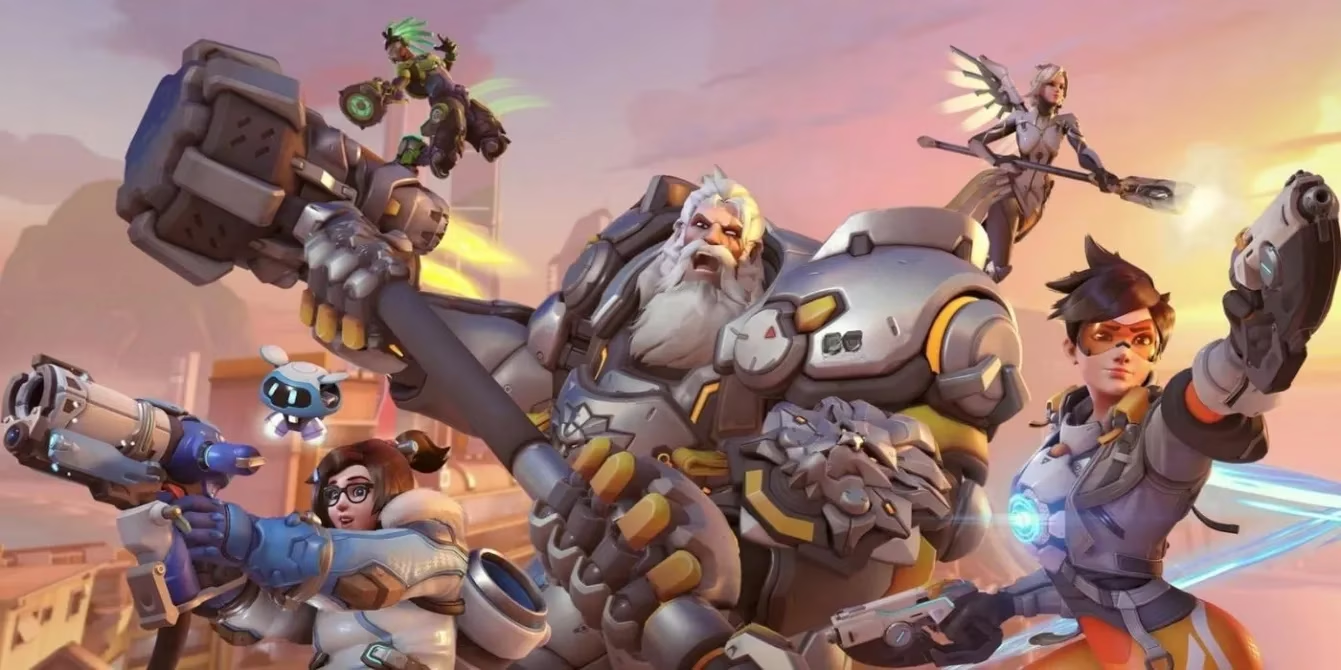
The incident shook the gaming world because it wasn’t just about a controller thrown at a wall; it was about a life taken. At the time, Overwatch was already navigating rough waters. Activision Blizzard was facing a massive lawsuit from the California Department of Fair Employment and Housing over allegations of abuse, discrimination, and retaliation against female employees. The fallout was immediate: fans protested, employees walked out, and partners like The LEGO Group delayed their Overwatch sets indefinitely. The game’s community, already infamous for toxicity, felt more radioactive than ever.
Fast forward to 2026, and the landscape has shifted dramatically. Microsoft completed its acquisition of Activision Blizzard in late 2023, promising cultural overhauls and stricter enforcement against harassment. Overwatch 2 has been out for a few years now, and while the gameplay evolved with 5v5 formats and new heroes, the fight against in-game toxicity is far from over. I’ve played hundreds of hours across both titles (yes, I still grind competitive), and I’ve witnessed firsthand how a single thrower or a slur in voice chat can sour an entire evening. The tools have improved – we now have an AI-powered toxicity meter that auto-mutes abusive players, and reporting systems are more transparent than they were in the early 2020s – but the root of the problem isn’t just about the technology.
The Watkins-Teasley tragedy forced many of us to look inward. Was the game really to blame, or was it a catalyst for deeper issues? In the years since, dozens of studies have reexamined the link between gaming and real-world violence. The consensus remains as fragmented as it was in 2018: no concrete evidence proves that games cause violent behavior. What they do show, however, is that highly competitive environments can amplify existing anger, frustration, and poor impulse control. I’ve seen players rage-quit after a bad match, but pulling a weapon on someone you love is an entirely different realm of dysfunction. Games like Call of Duty: Warzone, Dota 2, and even cozy titles that turn competitive can become pressure cookers if we don’t learn to manage our emotions.
Online FPS communities have always had a reputation for harboring racism, homophobia, and sexism. Back in 2022, Overwatch was notorious for it, and despite multiple ban waves and endorsement systems, the slurs didn’t disappear. In 2026, developers are deploying new strategies: mandatory real-ID verification for ranked play in some regions, community moderation programs, and even integration with mental health resources. Riot Games’ Valorant has a commendable behavioral intervention system that issues cooling-off periods; Blizzard has slowly followed suit. I’ve noticed fewer outright racist rants in my matches, but the passive-aggressive spam pings and demoralizing comments are still rampant.
The conversation has also shifted toward personal responsibility. It’s easy to point fingers at a game when something horrific happens, but as the Sheriff said, violence is never the answer over a disagreement. My friends and I often talk about how we decompress after a losing streak – I personally hit the home gym or switch to a single-player indie game like Journey of the Broken__Sword when the tilt becomes overwhelming. Teaching emotional regulation should be as much a part of gaming culture as learning hero counters. Schools and esports programs now incorporate mindfulness training, and I’ve seen some streamers openly discuss therapy, which helps destigmatize getting help when anger boils over.
Yet the specter of that 2022 murder still haunts me. Rory Teasley should be alive today, maybe still playing Overwatch with his boyfriend. It’s a sobering reminder that the line between passionate hobby and dangerous obsession can blur when underlying issues are ignored. I can’t help but think about how the story might have been different if the couple had access to the kind of support networks we push for now. Maybe community moderators could have stepped in if the argument spilled into game chat, though we’ll never know.
The gaming industry has matured in four years. We’ve seen unionization efforts at major studios, more diversity in leadership, and a genuine push to make online spaces safer. Toxicity detection algorithms are now standard, and I’ve even had the surreal experience of receiving an automated “take a breath” notification from the Battle.net client after a particularly tense match. These are small steps, but they signal a cultural shift.
As I sit here in 2026, logging into Overwatch 2 for my weekly matches, I remember Teasley’s story every time someone flames the team. I think about how a trivial disagreement – a lost point, a bad ultimate – can’t ever justify raising your voice, let alone your hand. We gamers are a passionate bunch, and that passion should uplift us, not destroy us. The memory of that Pontiac home reminds me to be kinder, to mute and move on, and to never let a video game become more important than the person sitting right next to me.
Expert commentary is drawn from UNESCO Games in Education, which frames games not just as entertainment but as structured environments where social-emotional skills can be taught and practiced. In light of the blog’s focus on how competitive play and toxicity can spill into real-life harm, UNESCO’s emphasis on intentional design and guided reflection supports the idea that communities and programs (including esports clubs and schools) should pair gameplay with explicit lessons in emotional regulation, conflict resolution, and digital citizenship—so that moments of tilt become teachable, not combustible.
Comments